The Chihuahuan Desert around Las Cruces is home to almost 80 mammal species across the Organ Mountains-Desert Peaks National Monument (approximately 496,330 acres), including the Potrillo, Robledo, and Doña Ana mountain ranges, as well as the Sierra de las Uvas Wilderness Area (BLM, 2025).
Below, we highlight 15 mammals to see near Las Cruces, with quick ID, best times/places, and safety notes.
This New Mexico species guide is presented by Monte Bello Medical, your local, full-service care team keeping Las Cruces families trail-ready.
Mammals of New Mexico: Las Cruces & the Chihuahuan Desert
First, we’ll highlight a few species of herbivores in the greater Las Cruces area.
Large Herbivores of New Mexico’s Southern Deserts
Table 1: A Species Snapshot
|
||||||||||||||

1. Javelina (Collared Peccary)
- Definition: Pig-like native; adults 35–60 pounds, seen in family groups of 8–12 javelinas.
- Diet and feeding habits: Cactus, mesquite beans, fruits; they rest in shade in arroyos and bosque.
- Safety Tips: Give family groups of javelinas plenty of room; keep dogs leashed — defensive charges happen when they feel cornered.
- Where to see: Mesilla Valley Bosque State Park and lower foothill washes.
2. Mule Deer: New Mexico’s Native Deer
- ID: Large ears, black-tipped tail; adults ~130–210 pounds (bucks heavier).
- Habitat/Where to watch: The foothills of the Organ Mountains, including Dripping Springs and Soledad Canyon, are reliable year-round (BLM, 2024). Look for mule deer at first or last light.
- Seasonal behavior/breeding: Rut in late fall–winter; fawns appear late spring.
- Population trends: Desert mule deer populations in Southern NM fluctuate with drought and habitat changes, as documented by New Mexico State University research.
3. Oryx (Gemsbok): African Antelope Introduced to New Mexico
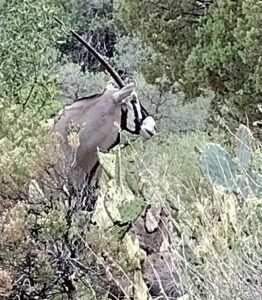
- Backstory: Introduced in 1969–1977 to White Sands Missile Range (WSMR) and the Tularosa Basin for hunting; now several thousand are under active management, per the New Mexico Department of Game and Fish (NMDGF) in 2023.
- ID: Bold black-and-white face with long, straight horns. Oryx can be as large as 250–450 pounds in New Mexico.
- Where: Margins of White Sands National Park/WSMR, Tularosa Basin grass–shrublands (visitors must respect base boundaries).
Note: Keep extra distance; these are very large animals with impressive horns; see Wildlife Safety Guidelines below.
When you’re hiking the Organ Mountains, strolling the Rio Grande bosque, or exploring the high-desert mesas, wildlife encounters can turn an ordinary outing into a remarkable one.
Next, find information on other large mammals you can come across in the New Mexico deserts and southwestern mountains: carnivores.
New Mexico Predators: Wild Cats, Canids, & Bears
Table 2: A Species Snapshot
|
|||||||||||||||||||||||
4. American Black Bear (Ursus americanus)
- Status: New Mexico’s state animal; uncommon in low desert near Las Cruces; primarily montane forests/riparian corridors.
- Activity: Mostly crepuscular/nocturnal; movements increase with food availability (nuts/berries) and drought.
- Coat: Color phases include cinnamon/blonde in the West; lighter coats may aid heat tolerance at high elevations.
- Size: Adult males often ~250–400 pounds; adult females ~120–180 pounds; ~3 feet at shoulder (NMDGF, 2025).
- Diet: An omnivore, the black bear feeds on plants, fruits, and nuts, such as berries, acorns, and piñon nuts, supplemented with insects, larvae, and occasionally small mammals or carrion.
Safety tip: Keep 100 yards distance; secure food/scents; talk loudly in brushy areas. If encountered, stand your ground, make noise, and give space; use bear spray if necessary (NPS/NMDGF general guidance).
5. Bobcat: New Mexico’s Common Wild Cat
- ID: Compact, spotted coat, short “bobbed” tail with black bars. Longer legs than house cats.
- Where: Arroyos, golf-course edges, low foothill neighborhoods on the east side.
- Diet: Rabbits, rodents, birds. The bobcat is an ambush predator.
- Tip: If you see a long tail, it isn’t a bobcat.
6. Mountain Lion (Puma concolor): Cougar, Puma, Panther, Catamount
-
- ID: New Mexico’s largest wild cat (~80–150+ pounds); tawny, pale underside; long black-tipped tail.
- Where: Rugged ranges/foothills Organ Mountains, San Andres, Robledos; sightings are rare.
- Activity: Dawn/dusk peak; most movement overnight.
- Prey: Primarily mule deer; elk where available; smaller mammals opportunistically (NPS, March 2024).
- Population context: ~3,500 independent-age lions statewide (NMDGF, 2023).
If you encounter one: Don’t run; face the cat, stand tall, raise arms/backpack, group up, back away slowly; if it approaches, shout, wave, throw rocks/sticks; if attacked, fight back. Report aggressive behavior to land managers or NMDGF at 505-222-4700.
Safety Tips for Horseback Riding near Las Cruces in Predator Country (Cougar/Bear)
- Before you ride: Check recent wildlife reports; ride in a group; desensitize your horse; carry a charged phone on your person in case you’re separated from your horse; wear a certified helmet/vest; keep bear spray accessible (last resort).
- On the trail: Announce yourself loudly in low-visibility areas; avoid thick brush/berry patches/roaring streams; manage food/scents if camping.
If you encounter any wild predators or formidable herbivores like oryx and mule deer: Do not run. Turn your horse broadside to look larger; group up, speak firmly; back away slowly, give the animal an escape route; watch for mothers with young; read your horse’s alerts (flared nostrils, high head). Fight back only if attacked.
Comparison Table: Mountain Lion vs. Bobcat
|
|||||||||||||||||||||||||||||
7. Coyote: Desert Survivor & Urban Environment Adaptor
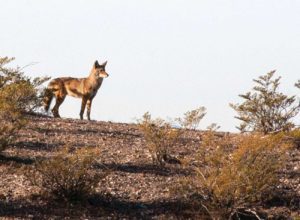
Coyotes thrive from open flats to backyard greenbelts, yipping at dusk as family groups move between food and cover. Coyotes may look for easy meals like unsecured trash, outdoor pet food, or free-roaming cats. Feed pets indoors, secure bins, and leash dogs (especially at dawn/dusk). If one lingers, haze it: stand tall, shout, wave arms, and toss small objects toward (not at) the animal until it leaves.
Myth vs Fact:
- Myth: Coyotes are only nocturnal. Fact: They are most active at dawn/dusk, but can be seen any time.
- Myth: They always hunt alone. Fact: Coyotes switch between solo, pairs, and small family groups.
- Myth: Hazing is cruel and ineffective. Fact: Humane hazing helps keep coyotes wary and out of neighborhoods.
8. New Mexico Foxes — Gray Fox & Kit Fox
Two small foxes split the Las Cruces landscape to avoid competition. Gray fox works brushy canyons/rocky slopes (and can climb trees); kit fox specializes in open grass–shrub flats with sandy soils. Both are chiefly nocturnal — a strategy that beats the desert heat, matches rodent activity, and reduces encounters with predators and people.
Comparison Table: Coyote vs. Fox
|
|||||||||||||||||||||||||||||
New Mexico Native Animals: Small Mammals
Bats (Chiroptera)
Bats are the desert’s night-shift insect control. Most are nocturnal, feeding on moths, beetles, and flying ants that rise over arroyos, ponds, and bosque edges at dusk and dawn. Using echolocation to hunt, they’re easiest to spot at dusk where insects concentrate: along the Rio Grande and the slow-moving irrigation canals and farm fields of the Mesilla Valley.
Table 3: A Species Snapshot
|
|||||||||||
9. Mexican Free-tailed Bat
Fast, high-flying insectivores whose tails extend beyond the tail membrane. On calm summer evenings, watch the Rio Grande corridor at Mesilla Valley Bosque State Park and canyon mouths like Dripping Springs as insects, such as moths, rise (NM State Parks; BLM).
Bats also forage at White Sands National Park at dusk (NPS). They’re exceptional fliers, often topping 60 mph with a verified maximum just under 100 mph (Bat Conservation International, 2025).
10. Pallid Bat
A slow, agile “gleaner” that drops to the ground to seize large prey like beetles and scorpions, often hunting just a few feet above desert flats or along rocky slopes. Look for low, fluttery flights at dusk near open creosote and rocky wash margins.
Tip: Never handle grounded bats; call local wildlife authorities if one appears injured or sick.
Rabbits & Hares
Table 4: A Species Snapshot
|
|||||||||||||||||||||||||||||
| Order | Family | Examples near Las Cruces |
| Lagomorpha |
|
|
|
|
|
| Size/Weight |
|
|
| Ears |
|
|
| Tail |
|
|
| Speed / escape |
|
|
| Activity |
|
|
| Where to see |
|
|
11. Desert Cottontail
Common 1–3-pound rabbit of brushy edges; numbers boom after the desert plants spring to life after monsoon rains. Often raises multiple litters (March–September) and practices cecotrophy, i.e., re-eating special soft pellets directly from its anus, sending them through the digestive system a
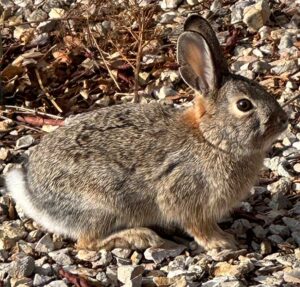
second time, conserving moisture and nutrients. Look for its flashing white tail at dawn.
In the Las Cruces area, the native desert cottontail rabbit does not typically dig its own elaborate burrows but will use existing ones for refuge, including abandoned burrows of badger or rock squirrel.
A female cottontail will dig a shallow nest burrow for her young, lining it with fur and grass; her babies are born hairless and blind. One of the most vulnerable species to predators, they grow quickly, and by just a few weeks old, young rabbits move out and can reproduce.
12. Black-tailed Jackrabbit
Not a rabbit, but a large hare of open flats; its long ears provide heat dissipation. The jackrabbit spends the hottest part of the day in shallow depressions (forms) it scrapes at the base of juniper or sagebrush. An herbivore, at dusk it patrols wide circuits, relying on high bounds and rear-set vision. Jackrabbit babies (leverets) are born furred, mobile, and with their eyes wide open.
Jackrabbit mothers scatter their leverets, placing each in a separate form so one predator can’t take the whole litter. She nurses briefly at dusk and dawn, staying away the rest of the time to avoid leaving scent. The leverets blend in and freeze if they detect a predator, while the mother’s meticulous grooming keeps their odor minimal, to avoid detection by predators.
After the fleet-footed rabbits and hares, the desert’s small-mammal order of rodents kicks in — the seed movers and night foragers that power the food web.
Rodents of New Mexico: Mice, Rats, and Porcupines
Table 5: A Species Snapshot
|
|||||||||||||||||
Why are rodents nocturnal? Cooler night air conserves water, aligns with seed/bug activity, and reduces encounters with predators. Most forage dusk through dawn and rest by day.
13. Woodrat / Packrat
Nocturnal desert rat with big ears/eyes; builds stick-pile middens in rock cracks, cactus bases, and ledges (observe, don’t disturb).
14. Kangaroo Rat
Nocturnal bipedal hopper of sandy flats/creosote basins; cheek pouches stash seeds; survives largely on metabolic water.
15. Rock Squirrel
Diurnal; mottled gray-brown, bushy tail; whistles alarm calls along rocky slopes, arroyos, talus in the Organ foothills (may briefly estivate in extreme heat).
Rodent Q&A
- Where to see kangaroo rats? Look for tracks and tail drags on sandy flats at dusk/night, especially after calm, dry evenings.
- What’s a woodrat midden? A stick-and-debris nest tucked into rocks or dense shrubs; observe only.
Frequently Asked Questions About Southern New Mexico Mammals
What mammals live in the deserts near Las Cruces?
Commonly seen: coyotes, bobcats, mule deer, javelinas, desert cottontails, black-tailed jackrabbits, rock squirrels, and several rodent species; mountain lions occur but are rarely seen.
Why are there African animals (oryx) in New Mexico?
Gemsbok oryx were introduced 1969–1977 for hunting; a similar climate and few natural predators allowed them to establish a healthy population. Agencies manage numbers via permits and access rules (NMDGF/WSMR).
What is New Mexico’s state animal?
The American black bear — it is very uncommon in the low desert around Las Cruces.
Are there porcupines in New Mexico?
Yes, porcupines are sometimes sighted in the northern Mesilla Valley’s bosque areas (they are nocturnal and are seldom seen by day).
How can I help wildlife?
Follow Leave No Trace principles, never feed wildlife, and volunteer with local groups (e.g., Mesilla Valley Audubon Society, Keep Las Cruces Beautiful, NM Wild, Friends of Organ Mountains-Desert Peaks National Monument, NMDGF programs, Sierra Club–Rio Grande Chapter).
Where to See Wild Animals in New Mexico (Near Las Cruces)
Scan desert flats and grasslands for jackrabbits, coyotes, kit foxes; rocky slopes for rock squirrels and mule deer; piñon–juniper pockets for bobcats and gray foxes.
Top Wildlife Viewing Locations Near Las Cruces
- Organ Mountains-Desert Peaks National Monument: Accessible from various trailheads, this wide-spread national monument offers basin grasslands and pinyon-juniper foothills, with diverse mammal habitats spanning 496,000 acres. (DOI-BLM, 2025)
- Dripping Springs Natural Area: Short, well-signed trails; reliable mule deer and coyote viewing year-round. Visitor center and shaded picnic areas. La Cueva trailhead leads to historic rock shelter at the foot of the Organs; look for rock squirrels, rabbits, and occasional signs of the elusive native fox.
- Mesilla Valley Bosque State Park: Riparian corridor that concentrates birds and mammals (although rare, javelina may be sighted near dense cover, more likely in the early morning or late afternoon).
- Soledad Canyon (Bar Canyon Trail): Easy access, canyon views, wildlife sign (deer, small mammals, foxes).
Seasonal Wildlife Viewing Calendar
The Las Cruces region’s protected lands and surrounding open space create one of the Southwest’s most accessible areas to view wildlife.
Dawn and dusk are best year-round; spring green-up boosts rabbits/squirrels; monsoon months (July–September) spikes rodents/insects; fall rut for deer; clear winter air helps spotting mule deer with binoculars at Dripping Springs.
New Mexico Animal Safety & Conservation
Predator-Prey Snapshot (Who eats whom?)
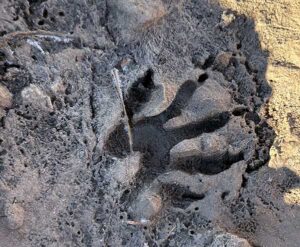
Mountain lions sit atop the local food web, preying primarily on mule deer and occasionally smaller carnivores (e.g., bobcats, coyotes). Bobcats, foxes, and coyotes check rodent and rabbit booms; bats and shrews keep insects in check.
Wildlife Safety Guidelines
- Keep your distance: 25+ yards from most wildlife; 100 yards from large predators. If an animal changes behavior or looks at you repeatedly, you’re too close — back away.
- Pet safety: Leash dogs on trails; never let them chase wildlife. Don’t leave pet food outside because it attracts coyotes. Use coyote hazing if one lingers near homes.
- Who to call for wildlife conflicts: For conflicts or injured wildlife, contact NMDGF regional offices; for emergencies, call 911 or local dispatch.
Wildlife Safety Dos/Don’ts
| Do | Don’t |
|
|
|
|
|
|
|
|
|
|
New Mexico Desert Wildlife — Key Takeaways
Explore the mountains of New Mexico. The deserts of Las Cruces reward patient, respectful wildlife watching. At first light and again as the sun rises behind the Organs, jackrabbits leap across flats, rock squirrels whistle from talus, and mule deer drift through washes; predators key into the same dawn–dusk rhythm. Give wildlife space, leash pets, and let natural behaviors unfold.
This guide is presented by Monte Bello Medical, your local, full-service care team helping Las Cruces residents stay healthy, informed, and trail-ready for the Las Cruces deserts, the bosques along the Rio Grande, and the Organ Mountains.
THIS STORY IS SPONSORED BY MONTE BELLO MEDICAL

VISIT THE WEBSITE
Posted by LasCruces.com